Performance
The same genomes and GP expressions can be timed on both libraries.
The chart below is mean wall time of one deap-er run for each
component. Shared DEAP↔deap-er cases append
(deap_er − deap) / deap × 100 in parentheses (negative means
deap-er was faster than DEAP). Unique deap-er features show the time
only. Figures and multipliers below come from
reports/deaper_perf_bench.json (deap-er 3.0.0 vs DEAP 1.4.4).
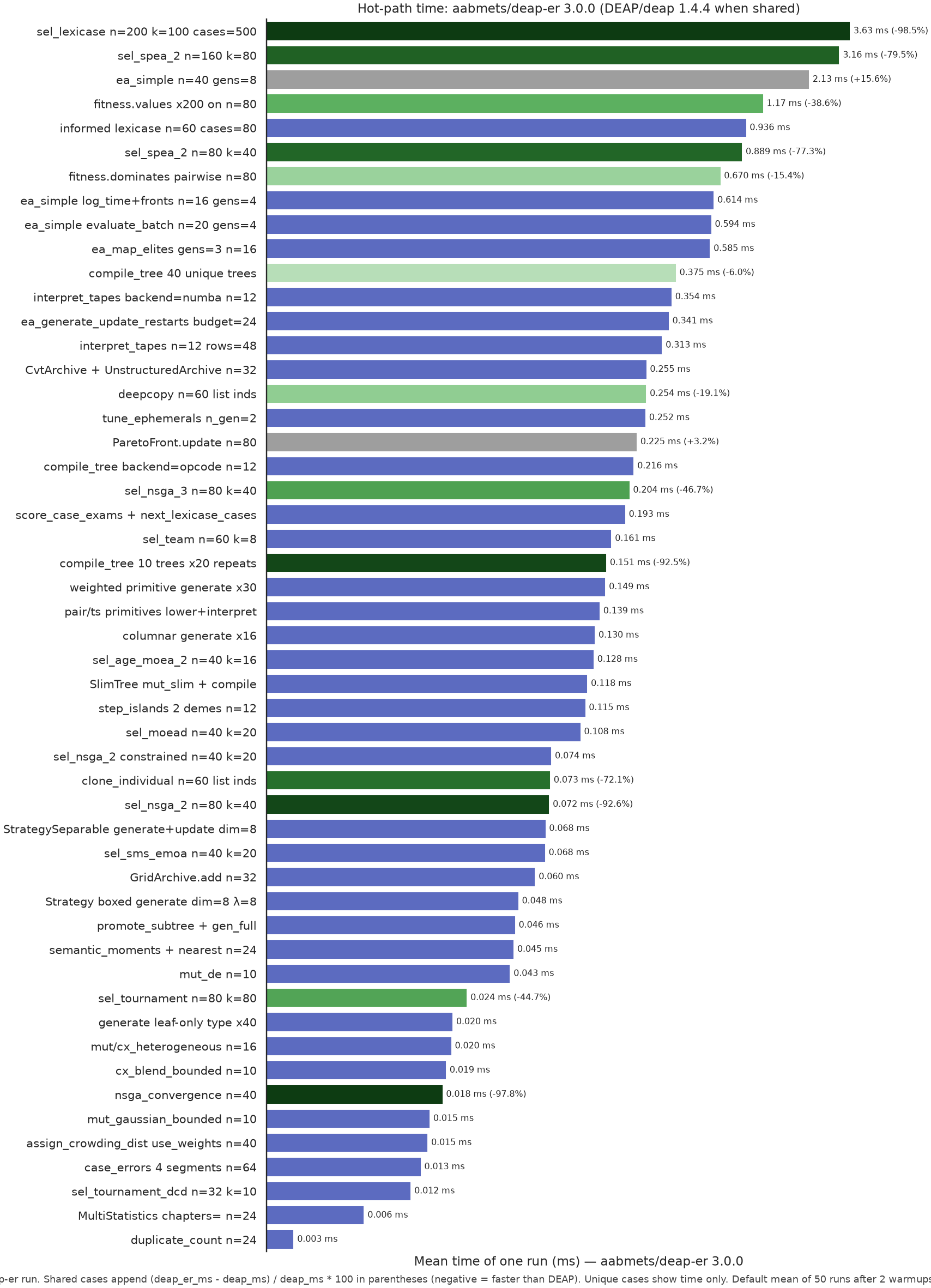
Bar color is the comparison class, not the time:
- Green — shared DEAP↔deap-er case where deap-er is faster. Darker green is a larger improvement versus DEAP, scaled to the biggest win on the chart.
- Gray — shared case where deap-er is slower than DEAP, or where percent change is missing.
- Indigo — deap-er-only feature (no DEAP counterpart).
Each bar is the mean of 50 timed runs after 2 warmups unless the JSON
notes field records a smaller repeat for a heavy CMA, MAP-Elites,
or Numba path. Versions in the title are the packages that produced
the JSON, not whatever is installed when the figure is redrawn.
Shared cases keep the same workloads as the previous DEAP comparison.
What is faster than DEAP
The largest shared-case gains sit on numeric or cached work that DEAP
still does in Python loops. Relative speed is deap_ms / deap_er_ms
from the report:
sel_lexicase(~68×) — case filtering runs on a packed(n_individuals, n_cases)matrix with NumPy boolean masks instead of per-case Python list comprehensions. Optionalmatrix=lets informed down-sampling and lexicase share one array per generation.nsga_convergence(~45×) — pairwise distances go through SciPycdiston fitness coordinates, not a Python double loop over genes.sel_nsga_2/sel_spea_2/sel_nsga_3(~14× / ~5× / ~1.9×) — dominance and niche assignment are vectorized. NSGA-II ranks withmoocore.pareto_rank. SPEA-II density rows stay the original upper-triangle layout so the RNG stream is unchanged. The larger SPEA-II case (n=160) is ~4.9×; n=80 is ~4.4×.compile_treerepeats (~13×) — the defaultevalbackend is cached by expression text and context identity with LRU eviction at 1024 entries. Both libraries compile the same shared source strings. The first compile of 40 unique trees is slightly ahead of DEAP (~1.06×); repeating the same ten trees is about 13× faster.clone_individual(~3.6×) — a shallow copy of alist/array.arrayindividual plus a deepcopy of fitness. The defaultToolbox.cloneis stilldeepcopy(~1.2× on list individuals). Register the fast clone when genes are a plain sequence and extra state is only fitness. See Differences with DEAP.sel_tournament(~1.8×) — all contestant indices come from onerng.integers(..., size=rounds * contestants)draw. Winners are compared in Python. That stream differs from scalarchoice.fitness.valuesreads (~1.6×) — the tuple is cached after the first assignment.fitness.dominates(~1.2×) — one-, two-, and three-objective cases unpackwvaluesand compare directly. Other arities use an indexed loop.
What is slower than DEAP
Two shared cases on this machine sit under the DEAP baseline:
ea_simple— about 0.87× DEAP (2.13 ms vs 1.84 ms on n=40, 8 generations). Isolatedsel_tournamentis ahead of DEAP. Flip-bit mutation now drains leftover uniforms withrng.take_floats(same stream asrandom()). Crossover still draws one scalarrng.randomper mate-or-skip decision. DEAP uses CPython'srandommodule for those. deap-er's process-wide RNG is a NumPyGeneratorfacade (buffered uniforms and leftover integers) so one stream can be seeded, checkpointed, and matched by golden tests. A NumPy-backed uniform is still more expensive than CPythonrandom, so a tiny OneMax-style loop that mixes those draws with variation loses.ParetoFront.update— about 0.97× DEAP (0.225 ms vs 0.218 ms on n=80). Near parity; the archive walk still uses the samedominatescompare against a growing archive.
Those cases do not cancel the lexicase, selection, clone, and compile
wins. A run that spends its time in lexicase, SPEA-II, NSGA-II/III,
or repeated GP compile will see those shared bars improve. A tiny
OneMax loop that is almost entirely uniform draws in variation will
look like ea_simple.
Unique features
The same bench also times deap-er-only capabilities from the
differences inventory (features, not bugs): boxed
operators and CMA, SMS-EMOA / MOEA/D / AGE-MOEA-II, MAP-Elites
archives, island stepping, columnar GP tapes, SlimGP, and related
helpers. Pure docs or API cosmetics (tree_to_infix, call_zero,
empty Logbook header, logbook JSON, ea_* logger) are skipped.
How to reproduce
From the repo root, with the dev extra (DEAP and seaborn):
Both deaper_perf_bench.json and deaper_perf_bench.png land in the
same directory (reports/ by default) and overwrite files already
there. tools/bench_hotpaths.py is a thin shim for the same entry.
The chart is written by importing write_chart directly (no
subprocess). To redraw the figure from an existing JSON, call
plot_main from tools/perf_bench with the same -d. Copy
reports/deaper_perf_bench.png to docs/images/deaper_perf_bench.png
to refresh the page figure.
Both libraries receive the same numeric genomes and the same GP expression strings on shared cases. First-time compile skips warmup and clears deap-er's compile cache on every sample.